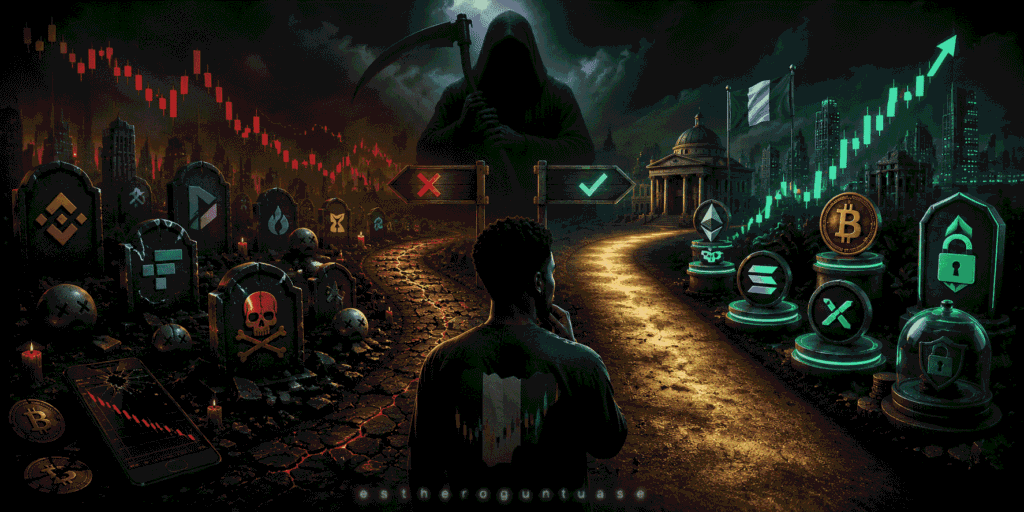
RootData tracked tens and hundreds of crypto projects that filed for bankruptcy or went permanently inactive by late July and early August 2026, with the total climbing toward 110-124 in later tallies. The pace increased in the final weeks of July as exchanges, protocols, wallets, and layer-1 networks exited in clusters as the crypto winter bit deep. This is why we examine the 2026 crypto body count, considering the measurable wave of project failures and how they exposed unsustainable funding models, depleted token treasuries, weak operational resilience, and other factors across the industry. We then assess what these failed crypto projects in 2026 mean for Nigerian traders when choosing platforms.
Categories of Failed Crypto Projects in 2026
RootData compiled its 2026 tally by combining official shutdown announcements, bankruptcy filings, and projects whose websites and primary social channels stayed silent for more than six months. The list reached about 95 entries by late July and continued climbing past 110 thereafter. Closures spread across every major layer of the industry rather than concentrating in one niche.
Centralized exchanges had some of the highest-profile exits. BitMEX announced on 23 July that it would permanently cease exchange operations at 04:00 UTC on 23 September 2026. The platform halted new registrations at once and moved to reduce-only mode from 26 August so traders could only close or reduce positions. Similar to BitMEX, BitMart began an orderly wind-down on 26 July. It suspended new deposits and orders, and scheduled a full halt of spot and futures trading for 01:00 UTC on 26 August, with platform operations set to end on 31 January 2027. AscendEX closed earlier in August 2026 under the combined weight of MiCA licensing shortfalls and operational pressures. Several smaller venues followed the same path, thinning the mid-tier exchange landscape.
Layer-1 and Layer-2 infrastructure felt the same pressure. Moonbeam, a Polkadot parachain, stopped producing user transactions on 31 July after a migration window closed. The assets left on the chain or inside protocols deployed on it became inaccessible. Polygon zkEVM (July 3), Botanix (July 1), Loopring’s DEX (June 29), ICON (December 31), and PowerLoom also wound down or went permanently dark. These exits left users racing to bridge funds before deadlines. It also highlighted the risk of stranded positions on chains that just suddenly stop.
DeFi protocols took a large share of the body count. Goldfinch, ZeroLend, Ionic, Rage Trade, and Satori Finance shut down or filed for protection after token treasuries collapsed, and in several cases, after exploits drained remaining capital. Lending, credit, and perpetual-trading platforms proved especially vulnerable once secondary token liquidity dried up and rescue funding vanished.
Wallets, NFT platforms, gaming projects, analytics tools, and DAO tooling also joined the list. Leap Wallet, Ctrl Wallet, and Secondfi closed after security incidents or strategic reviews. Nifty Gateway and NFTfi exited the NFT market. Gaming titles and related infrastructure followed the same pattern of depleted incentives and fading user activity.
Then the four major announcements from BitMEX, BitMart, Movement Labs, and Storj Labs arrived within a single week, intensifying the crypto body count.
Why Did So Many Crypto Projects Fail in 2026?
Unlike the 2022 cascade, when the Terra algorithmic stablecoin failure triggered forced liquidations, and the later collapse of FTX revealed that many crypto firms were deeply linked by debt and leverage across the industry, the failures of 2026 occurred independently. Projects ran out of runway one by one as their individual economic models broke under the same structural pressures.
Supporting metrics underline the structural squeeze. Galaxy Research recorded $4 billion of venture capital deployed across 355 crypto and blockchain deals in the first quarter of 2026. This amounted to a 50% drop from the prior quarter. DeFi total value locked and trading volumes fell in the first half of 2026. Security firm Blockaid recorded more than $1.1 billion lost across 212 verified hacks in that period. TRM Labs counted 207 incidents that cost nearly $1 billion.
Liquidity Migration and Strategic Exhaustion
BitMEX and BitMart showed how even established venues could not survive once market share and funding dried up. BitMEX’s parent company, HDR Global Trading, announced the permanent closure after a strategic review of the business and the broader crypto industry. It had seen its market share shrink to a fraction of one percent as liquidity migrated to larger competitors. Years of regulatory costs and failed sale attempts left no viable path forward. BitMart similarly cited an evaluation of its operating conditions, market environment, and future strategic direction when it began its orderly wind-down. Mid-tier exchanges found themselves squeezed between rising compliance expenses and compressed trading fees, with no remaining capital cushion once volumes contracted.
Obsolescence and Migration Costs
Infrastructure projects suffered when early technical choices became liabilities. Loopring, one of Ethereum’s first production zk-rollups, shut its decentralized exchange after the team acknowledged it never gained meaningful adoption. Moonbeam also ended its Polkadot parachain operations on 31 July and migrated its token to Base, citing the need to redeploy resources toward a new direction. These examples show how older technology became outdated and how expensive it was to keep running networks that few people used. Once venture funding slowed down, projects that had raised money at high earlier valuations could no longer afford to stay open.
These failures are likely to change the environment in which Nigerian Traders’ Platform decisions take place. Every category that collapsed had once offered services that Nigerian users accessed, directly or through intermediaries. The scale and breadth of dead crypto projects therefore raise the cost of choosing venues that lack durable capital or clear exit pathways.
What are the Rising Uncertainties for Nigerian Traders?
Global platform failures now land directly on Nigerian users who routinely split activity across international exchanges and local apps. When a venue freezes withdrawals or a layer-2 network stops producing blocks, funds can become stranded. As weaker platforms exit, liquidity concentrates on fewer remaining options and raises concentration risk for anyone who relies on a single or lightly capitalized service.
Meanwhile, Nigeria’s own frameworks are responding. The SEC’s Accelerated Regulatory Incubation Programme has admitted multiple firms, including Luno Fintech Nigeria, Wrapped CBDC Ltd, and others, granting Approval-in-Principle status that permits supervised operations while full licensing remains conditional. Proposed rules published in August 2026 set high capital thresholds, ₦2 billion for digital asset exchanges and custodians, lower figures for other categories, alongside fidelity bonds, cold-storage requirements and extraterritorial reach over entities serving Nigerian residents. The CBN sandbox adds a further supervised track for virtual-asset activity. These measures raise barriers, improve visibility into operator strength and favor platforms that can meet the new standards.
The practical result for crypto trading in Nigeria is a clearer flight toward safer choices. Users usually prefer locally engaged platforms, or well-capitalized global venues that publish proof-of-reserves and maintain strong compliance. Choosing the best trading platform is no longer just about low fees or high yields. Crypto traders now consider checking regulatory status, capital strength and how reliably the platform can return funds when needed.
Lessons for Nigerian Traders on Platform Selection
The failures of several Web3 platforms teach a clear practical lesson: treat every platform choice as active risk management. Before depositing funds, check capital strength and insurance coverage. Also, demand recent proof-of-reserves or independent audits, and confirm custody practices such as the percentage of assets held in cold storage. Regulatory status has become pertinent so choose firms with SEC Approval-in-Principle under ARIP or clearer local engagement over those with none. Review how the platform handled past incidents, how reliably it processes withdrawals, whether its fee model is sustainable, and how transparent its governance is.
Watch for the red flags that appeared repeatedly among this list of dead crypto project cases. They include: heavy reliance on token treasuries, thin or non-existent real revenue, and rapid user growth that never translated into lasting stickiness. Diversify across more than one venue and move larger holdings into self-custody where practical. Keep simple monitoring habits so you notice problems early.
Furthermore, stay current with SEC and CBN updates, favor platforms that meet or exceed the required thresholds. Remember that the survivors of 2026 were those that generated real fees and maintained solid balance sheets. Choosing carefully today is the surest way to avoid the next wave of losses.