
On July 6, 2026, President Bola Ahmed Tinubu ordered an investigation into major technology companies operating in Nigeria.
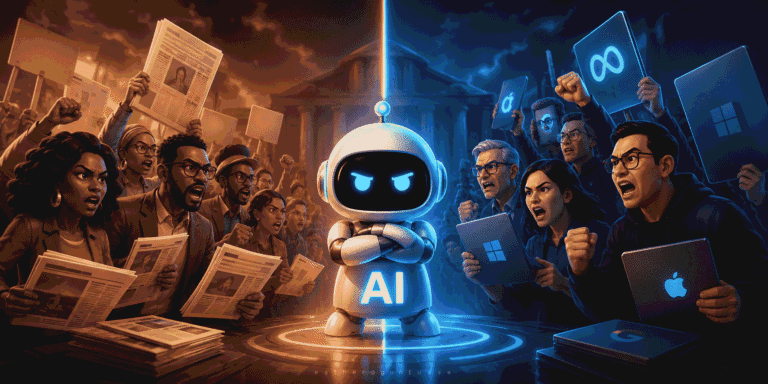
The directive followed a joint petition submitted by the Nigerian Press Organization (NPO), which comprises the Newspaper Proprietors’ Association of Nigeria (NPAN), the Nigeria Union of Journalists (NUJ), the Nigerian Guild of Editors (NGE), the Broadcasting Organizations of Nigeria (BON), and the Guild of Corporate Online Publishers (GOCOP).
Through the Federal Competition and Consumer Protection Commission (FCCPC), the federal government is now examining the serious allegations that these companies’ practices are undermining Nigeria’s media industry.
Why are publishers protesting?
The petition and the investigation that followed center on alleged unlawful use of news content and other unfair market conduct by Big Tech companies.
At the heart of the complaint lies the way generative artificial intelligence systems owned by these companies operate in Nigeria. Publishers argue that these AI models train on their news articles and journalistic content without seeking permission or offering any form of compensation.
The investigation letter, signed by the Honorable Minister of Information and National Orientation, Alhaji Mohammed Idris, makes clear that the inquiry will examine the actions of the companies involved without any presumption of wrongdoing.
Key issues under review include:
- Growing market dominance that weakens demand for the services of Nigerian media companies and publishers.
- Unfair competition through the scraping, ingestion, unauthorized extraction, and commercial use of original copyrighted journalistic material.
- The absence of fair compensation and the refusal to enter meaningful commercial agreements for the use of publishers’ content.
How do AI models use news content?
This is not the first time the FCCPC has investigated Big Tech. In 2020, the Commission partnered with the Nigeria Data Protection Commission (NDPC) on a 38-month joint probe into Meta Platforms and WhatsApp’s privacy practices and consumer data policies. On 19 July 2024, the FCCPC imposed a $220 million administrative penalty on Meta for discriminatory and exploitative practices against Nigerian consumers. Meanwhile, Meta appealed the fine.
This current investigation focuses squarely on the concerns raised by the NPO, with particular attention to the commercial use of news content by artificial intelligence systems. AI companies use news content in two main ways: to train their models and to power real-time answers and features after the models are built.
During the initial training of large language models, companies feed vast amounts of text into the system so the models can learn language patterns, facts, writing styles, and relationships between ideas. News articles form a valuable part of this data. They are well-written, fact-checked, and cover current events, politics, business, science, and culture. Once a model is trained, many AI systems no longer rely solely on their internal knowledge. Instead, they retrieve fresh news content the moment a user asks a question. This process, often called retrieval-augmented generation (RAG). This is how chatbots can answer questions about events that occurred after the model’s training cut-off.
Historically, much of this material came from large-scale web crawls such as Common Crawl, which repeatedly captured news websites. Reports show that news sites make up half of the top 10 sources in a Google dataset used to train some of the most popular large language models, including those developed by Google and Meta. Publishers have documented that their articles appeared in these corpora without licenses.
Even without reproducing full articles, models trained or grounded on news content can generate concise summaries or answer factual questions in a journalistic style. Publishers argue that this reduces the incentive for users to visit original websites, cutting referral traffic and advertising revenue. Court documents in the New York Times case against OpenAI, for example, include instances where ChatGPT produced near-verbatim or closely paraphrased versions of Times reporting. Similar concerns appear in other publisher lawsuits and regulatory complaints, such as that of this current petition by NPO.
What should Nigerian publishers demand?
Anthropic agreed to a landmark $1.5 billion settlement in the class-action lawsuit Bartz v. Anthropic over the illegal downloading of large numbers of books from pirate sites. On 20 July 2026, the court granted final approval of the settlement. Although the agreement does not create binding legal precedent, it strengthens publishers’ bargaining position by demonstrating the commercial value of copyrighted creative works and the real financial consequences of unauthorized use.
Several major publishers worldwide have already secured formal content partnerships with OpenAI. The company has signed deals with more than 20 news organizations covering over 160 outlets in more than 20 languages. These range from the Associated Press agreement in July 2023 to partnerships with Brazil’s Folha and UOL in May 2026. The largest publicly reported deal is OpenAI’s multi-year agreement with News Corp, valued at more than $250 million over five years. These arrangements offer a practical example of what Nigerian publishers could pursue if meaningful commercial negotiations become possible.
Licensing deals have also emerged as one of the most concrete ways for publishers to capture value from AI companies. Beyond OpenAI, publishers such as the Associated Press, Axel Springer, the Financial Times, News Corp, Vox Media, The Atlantic, Time, Condé Nast, Hearst, The Guardian and The Washington Post have entered into agreements with companies including Amazon, Meta and Microsoft, etc. These deals cover the right to train models on archival content and the right to retrieve and display current articles in real-time answers, often with attribution and links. In some cases, the agreements also include technology credits, product collaboration, or revenue-sharing elements. The existence of these contracts shows that AI companies are willing to pay when publishers hold sufficient leverage and when the alternative is prolonged litigation or regulatory pressure.
Transparency on data use remains a critical missing piece in Nigeria’s current landscape. Most leading AI companies still provide only vague descriptions of their training data, often limited to phrases such as “publicly available information” or “licensed datasets.” This opacity makes it extremely difficult for publishers to know whether, how much, and for what purpose their content has been used. A stronger regulatory requirement for detailed, machine-readable summaries of training data, similar to the transparency obligations under the EU AI Act, would give publishers clearer evidence for negotiations or legal action. Without such transparency, rights holders are forced to rely on indirect analysis or costly discovery processes, as seen in this ongoing dispute.
Investigations and penalties only produce results when they carry credible enforcement power. Australia’s News Media Bargaining Code forced Google and Meta to negotiate payment deals with publishers by threatening binding arbitration and financial consequences. In the European Union, the combination of the Copyright Directive and the AI Act has created both rights and disclosure obligations that strengthen publishers’ position. Nigerian Publishers and the current FCCPC investigation can draw lessons from these examples. The more clearly the regulator signals that non-compliance will attract substantial penalties, the greater the incentive for AI companies to negotiate fair commercial terms rather than continue unlicensed use.
AI licensing as a real revenue stream for Nigerian Publishers
Australia’s experience shows that well-designed regulation can force meaningful payments. Under the News Media Bargaining Code, Google and Meta struck commercial deals worth an estimated $200–250 million annually to Australian publishers. Those funds helped expand newsrooms and sustain regional journalism. The European Union’s press publishers’ right has produced similar, though more uneven, licensing activity. When platforms face credible regulatory pressure, they often prefer negotiated deals over prolonged confrontation. Nigerian publishers could therefore treat AI licensing as a genuine revenue opportunity if the current investigation creates comparable leverage.
However, the downside is equally clear. Platforms have repeatedly responded to pressure by restricting or removing news content. Meta stopped renewing its Australian deals and reduced news visibility once the original code’s leverage weakened. In other markets, Google has threatened or implemented reduced snippets when forced to pay. Overly rigid rules risk the same outcome in Nigeria. Large technology companies could limit access to Nigerian news or deprioritize local content rather than pay. Licensing works best when regulation encourages negotiation without giving platforms an easy exit that harms publishers’ visibility and traffic in the long run.
What this implies for Big Tech vs Nigerian Publishers
The current FCCPC investigation highlights a structural tension between Nigerian publishers and journalists on one side and large technology and AI companies on the other. Big Tech platforms have expanded access to information and created new distribution channels, yet their commercial use of news content without clear compensation has weakened the financial base of local journalism. If regulators enforce meaningful transparency and fair negotiation, publishers stand to gain new licensing revenue and greater control over their work. Without effective enforcement, the same companies retain the upper hand, while smaller outlets and independent journalists risk further revenue loss and reduced visibility.
In the longer term, the health of Nigerian journalism will depend less on confrontation and more on whether both sides can convert regulatory pressure and allegations of unfair treatment into workable commercial arrangements that properly recognize and compensate original copyrighted work. Smart negotiation backed by credible enforcement offers the clearest path to a more balanced relationship.
About the Author