For years, conversations about Africa’s digital infrastructure have revolved around Johannesburg, Nairobi, Cairo, and Casablanca, but Lagos is now steadily emerging as one of the continent’s prominent data hubs with quiet, yet promising moves.
While many Nigerians associate Lagos with traffic, commerce, entertainment, and startup, the city is quietly experiencing a major transformation at becoming a critical location for storing, processing, and moving Africa’s data.
In the past year, Lagos has enjoyed significant private investment and notable government policies helping to drive this improvement.
Intelpoint data revealed that Africa had about 249 data centres as of February 2026. South Africa accounts for 25% of this figure with about 61 data centres, while Nigeria follows with 25.
According to the International Finance Corporation (IFC), Africa accounts for less than 1% of global data centre capacity. Despite its mobile data usage growing by roughly 40% annually, much of the continent’s data is still stored in data centres across the world.
This situation however created one of the biggest infrastructure opportunities on the continent which is now being tapped by several companies.
A recent Al-Jazeera report indicated that Lagos is West Africa’s digital hub with over 20 operational facilities and a data center market worth around $374 million. Major players are actively investing even as the industry still faces significant infrastructural hurdles linked to reliable power and fiber connectivity among others.
Lagos’s emergence is not accidental.
The city’s status as Nigeria’s economic capital makes it home to top FinTechs and several other local and international tech firms. Its coast-side location also provides direct access to subsea cables providing the bandwidth required for hyperscale digital infrastructure.
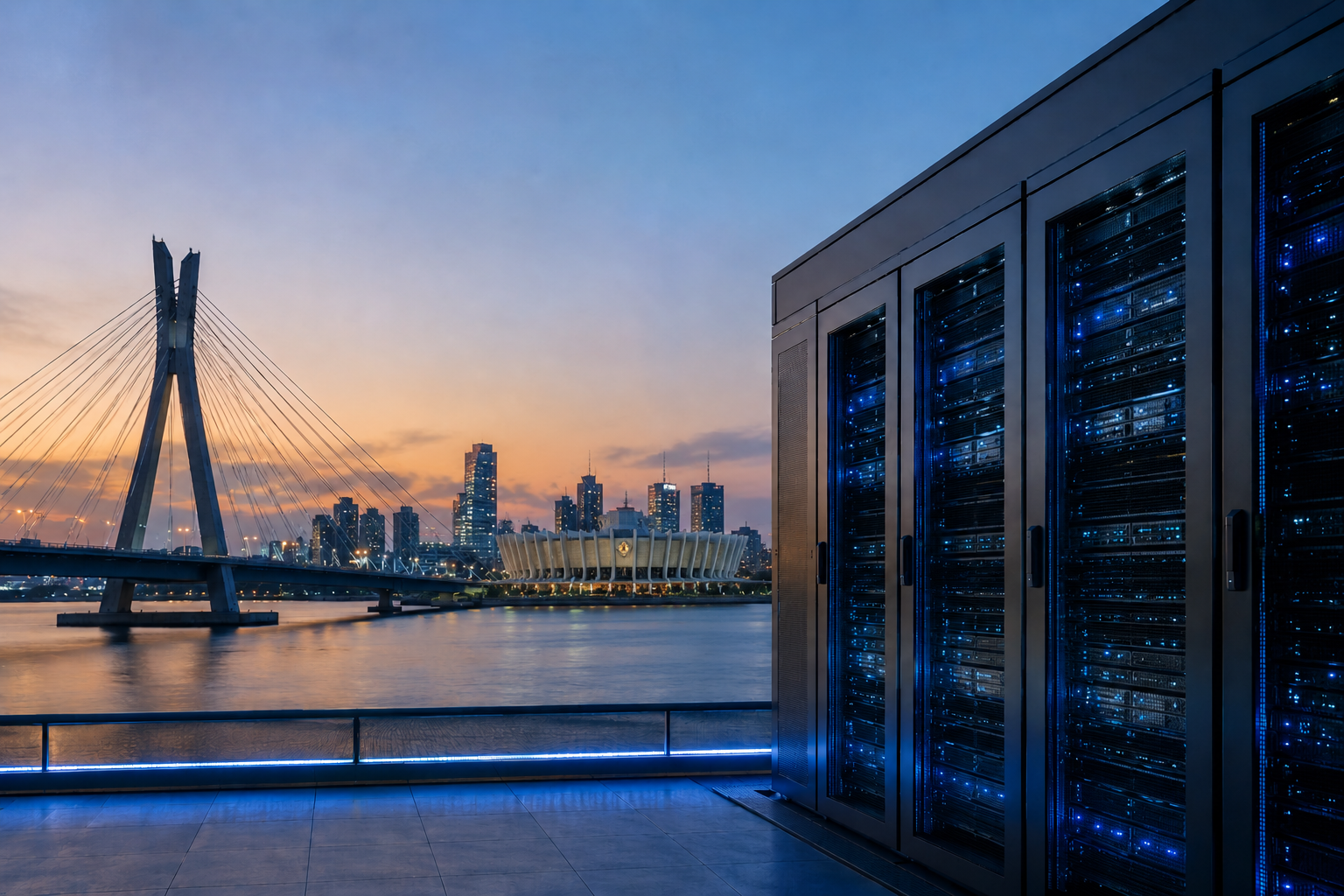
While Lagos has been housing data centres for over a decade, Rack Centre’s commissioning of its LGS2 facility last year signalled a major milestone for the city. The data centre supports 12 megawatts of IT load across six data halls and over 3,200 square metres of white space, according to a Data Center Dynamics report.
In the same year, other companies like Equinix and Open Access Data Centres (OADC) also made major moves. Specifically, OADC’s Lekki facility has a 20MW power capacity and directly connects to Google’s Equiano subsea cable. Equinix on the other hand launched LG2.3 with plans to invest $22 million in a new LG3 facility.
Beyond these, other companies like Kasi Cloud, Google, MTN, and Airtel are also actively making moves to boost Lagos’s data center market.
These investments are significant as they reflect confidence of a rising demand for local computing capacity expected to surge higher in the coming decade. They indicate that Lagos is now shifting from being a participant in Africa’s data centre race to a leading contender.
However, Lagos’ ambitions are not without obstacles.
Power issues threaten Lagos data centres
The issue of power availability emanating from regular grid failures has become the biggest constraint on data centre expansions. According to analysts, the electricity supply issue could determine whether the city could attract more digital infrastructure investments.
While existing companies have adopted several methods including solar and gas to power their facilities, Lagos is responding with ambitious policies to advance its control over its electricity markets.
In 2025, the state became the first in Nigeria to assume regulatory control over its electricity market. This involved moving to secure additional power supply arrangements to bolster overall provisions.
Lagos’ rise as a major data center hub for Africa goes beyond servers and buildings. Instead, it highlights a growing demand and a notable shift in the development of the continent’s digital economy.
Ultimately, Lagos’ retention of these investments and attracting new ones would depend on the delivery of a reliable power supply.
About the Author